

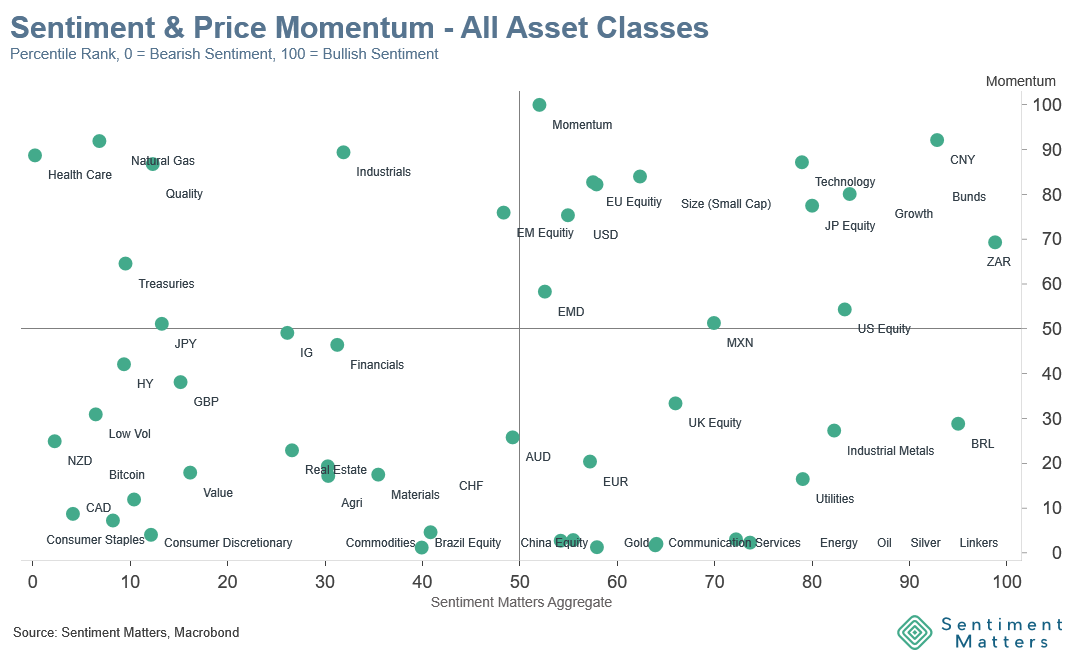
The latest Sentiment + Momentum maps are not showing one single dominant market message. But they are showing several useful shifts.
The most interesting opportunities are still mostly outside the obvious consensus trades. EM equities continue to combine strong momentum with only neutral sentiment. Industrials, Health Care, Real Estate, Agriculture and High Yield all sit in areas of the map where sentiment is still weak, but momentum has started to improve.
That is usually where this framework becomes most useful: not as a buy signal, but as a prompt to revisit the bearish narrative.
At the other end of the map, there are also some clear risk flags. US equities are now the most popular region, but momentum has softened. Communication Services has seen a sharp deterioration in momentum. Oil, Gold and Linkers all have weakening momentum, while sentiment remains more supportive than price action.
Currencies are the cleanest example of regime separation. Half the universe sits with positive momentum and bullish sentiment; the other half sits with weak momentum and bearish sentiment. But the more interesting story is the switch: the US dollar has moved from hated and weak to stronger momentum and improving sentiment, while the Swiss franc has moved the other way.
In short, this update is less about one big cross-asset call and more about where leadership is starting to shift, where bearish narratives may be worth challenging, and where crowded positives deserve closer scrutiny.
Before getting into the charts, a quick reminder of how the framework works.
Framework
We introduced the Sentiment + Momentum framework as a way to add an extra layer to the Sentiment Matters process.
The starting point is simple: sentiment helps identify where expectations are stretched, but sentiment extremes are rarely enough on their own.
An asset can be hated for a reason. It can stay hated for longer than you think. And without a catalyst, depressed sentiment can become a trap rather than an opportunity.
That is where momentum helps.
By combining sentiment with momentum, we are looking for assets where price action is starting to challenge the prevailing narrative.
The most interesting quadrant is usually unpopular but improving: assets where sentiment remains weak, positioning is likely still light, but performance has started to turn. These are not automatic buy signals. They are candidates for deeper work: what is the bearish narrative, where is it vulnerable, and what could force a rethink?
The mirror image is popular but weakening: assets where sentiment is still elevated, but performance has started to deteriorate. These are not automatic sell signals either, but they are useful risk flags. They ask whether the consensus has become too comfortable, whether the good news is already priced, and whether price action is beginning to challenge the bullish narrative.
In short, the framework is designed to help us spot two things:
Hated — but turning.
Loved — but fading.
It does not replace fundamental analysis. It helps decide where to focus it.