

One of my mantras is that sentiment analysis alone does not make an investment case.
But good sentiment analysis can improve almost every investment case.
That is the purpose of our Sentiment Ideas notes. They are designed to identify moments when investor sentiment, positioning and market expectations have moved far enough to create asymmetry in how an asset can react to events and news flow.
Almost by definition, these moments usually come with a dominant and sensible-sounding narrative. That narrative may be right. It may even be fundamentally well supported. But when too many investors have converged on the same view, the bar for further confirmation rises.
That is where sentiment analysis can help.
If you can identify parts of the prevailing narrative that you disagree with — or expect to play out differently — and if you can also identify catalysts that may force the market to reassess, then you have the core of a potentially interesting investment case.
Looking at the subsequent performance of assets covered in Sentiment Ideas notes can imply a more precise role in the investment process than sentiment analysis deserves. These notes are not a trading system. They are not designed to call every top and bottom. And they are not a substitute for fundamental work.
But transparency matters. So does process improvement.
In this note, we look back at the assets covered in recent Sentiment Ideas notes, the sentiment extremes we highlighted at the time, and what happened next. This is a transparent review of how the Sentiment Matters framework has worked in practice.
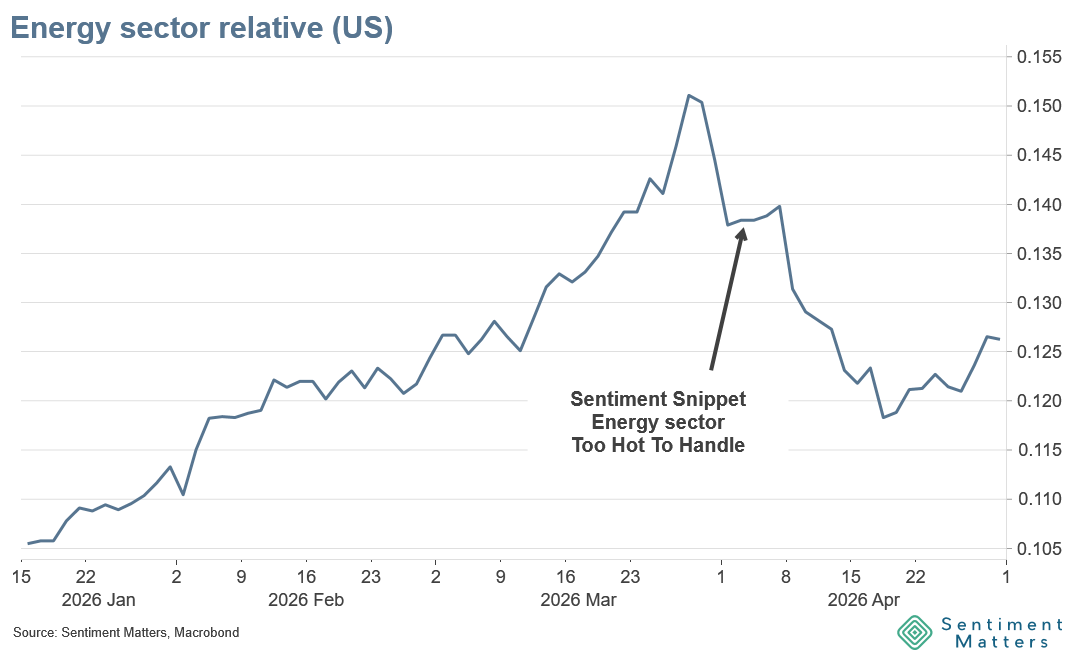
Energy – Too Hot To Handle?
Published: 2 April
Signal: bearish Energy sector relative
Core message: Energy sentiment had become too bullish, too quickly, leaving the sector vulnerable after a sharp sentiment and price surge.
At the time of publication:
- The average Energy sentiment indicator was at its 76th percentile.
- The Energy SMA had risen to the 86th percentile.
- Energy sentiment was the most bullish in 17 years.
- Six indicators were above their 90th percentile.
- Another four were above their 80th percentile.
- The only indicators not above the 60th percentile were slower-moving indicators that had not yet fully caught up.
Verdict
Published a few days after the sector’s relative peak, this was a good example of sentiment doing what it is supposed to do.
The note did not forecast every twist in the oil market. That was not the point. It identified that the Energy narrative had become crowded enough for the risk/reward to turn unattractive.
Kiwi Dollar Opportunities
Published: 8 January
Signal: bullish NZD