

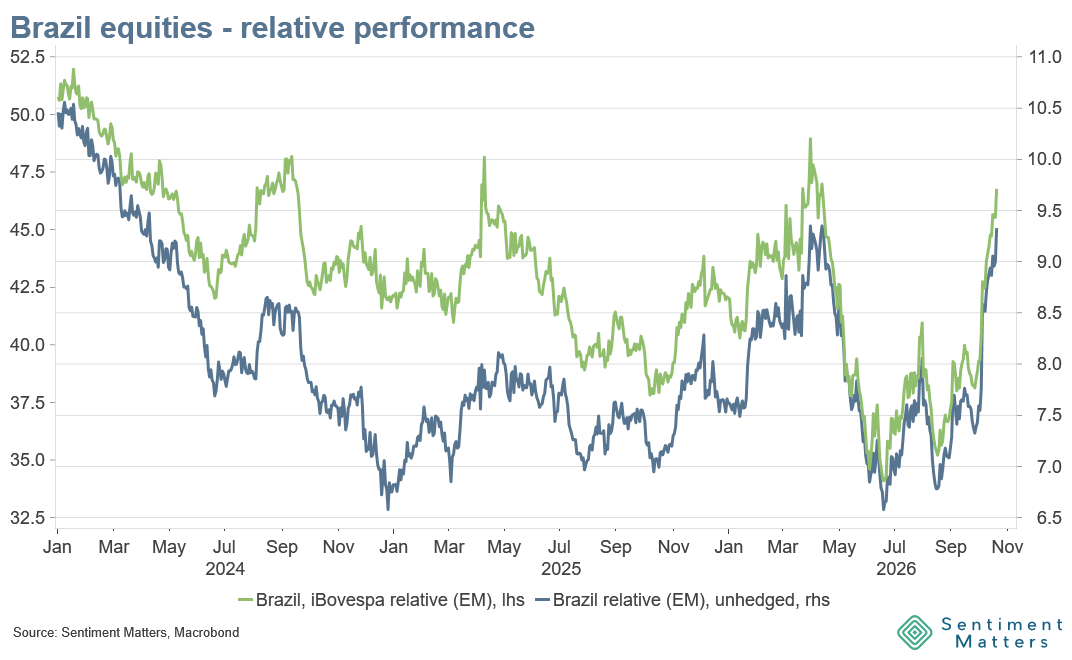
Brazilian equities have rallied strongly since the first round of the presidential election. Investors have marked up the probability of a Flávio Bolsonaro victory and, with it, the prospect of a more market-friendly economic agenda. Prices responded quickly. Sentiment has also turned increasingly bullish.
Our Brazil equity Sentiment Matters Aggregate has risen to the 43rd percentile, putting the headline reading broadly in neutral territory. But that understates the bullishness elsewhere in the indicators. Excluding the implied volatility gap, which is behaving unusually during this rally, takes the aggregate to the 76th percentile.
Foreign buying has led the rally, and financial institutions have also joined in. Individuals and domestic institutional investors remain less enthusiastic. Their participation could give the rally another leg, but it would also likely take sentiment towards the extremes that have historically been warning signs.
As always, this is a sentiment note. The aim is to assess where expectations and positioning stand, what could change them, and where the prevailing narrative may be vulnerable.
Sentiment & Positioning
We always start with the data.
Brazilian equities have rallied sharply since the first round, substantially outperforming emerging market peers. Our Sentiment Matters Aggregate has now risen from its pre-rally low at the 5th percentile to the 43rd percentile.
That is a meaningful recovery. The aggregate is well above its historical buy threshold and no longer offers the contrarian support that it did before the election.
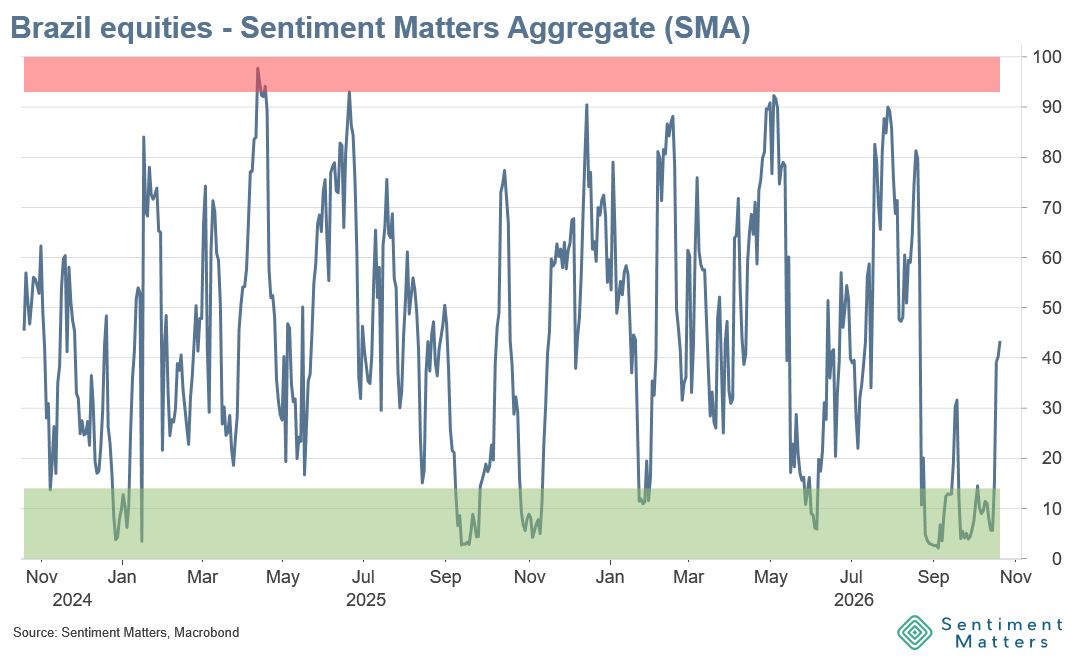
On the surface, the SMA is still surprisingly low, suggesting more lingering investor bearishness than the rally would imply.
The normal relationship between momentum and sentiment is that they roughly move alongside each other. Assets that perform well tend to become more popular, while falling prices usually dent investor confidence. When the two decouple, it can highlight an opportunity: a strong rally accompanied by subdued sentiment may suggest that investors have yet to fully embrace the move.
But before taking that interpretation at face value, we need to understand where the apparent lack of bullishness comes from. There are two main reasons why our SMA has not switched to show extreme investor bullishness: one technical and one related to investor behaviour.
Implied volatility: unusual behaviour
The technical reason lies in implied volatility. Normally, high implied volatility is associated with market stress. Investors become more uncertain, demand protection against losses, and pay more for options. Our SMA therefore treats elevated implied volatility as a sign of bearish sentiment. Historically, that kind of stress can create a more favourable starting point for subsequent returns.
But implied volatility measures the expected magnitude of price movements, rather than their direction. It can rise alongside sharply higher prices, too. That is what has happened in Brazil: the rally has been sufficiently sharp that implied volatility has risen with the market. In this episode, its increase reflects the strength of the bullish move rather than the usual pattern of stress accompanying falling prices.
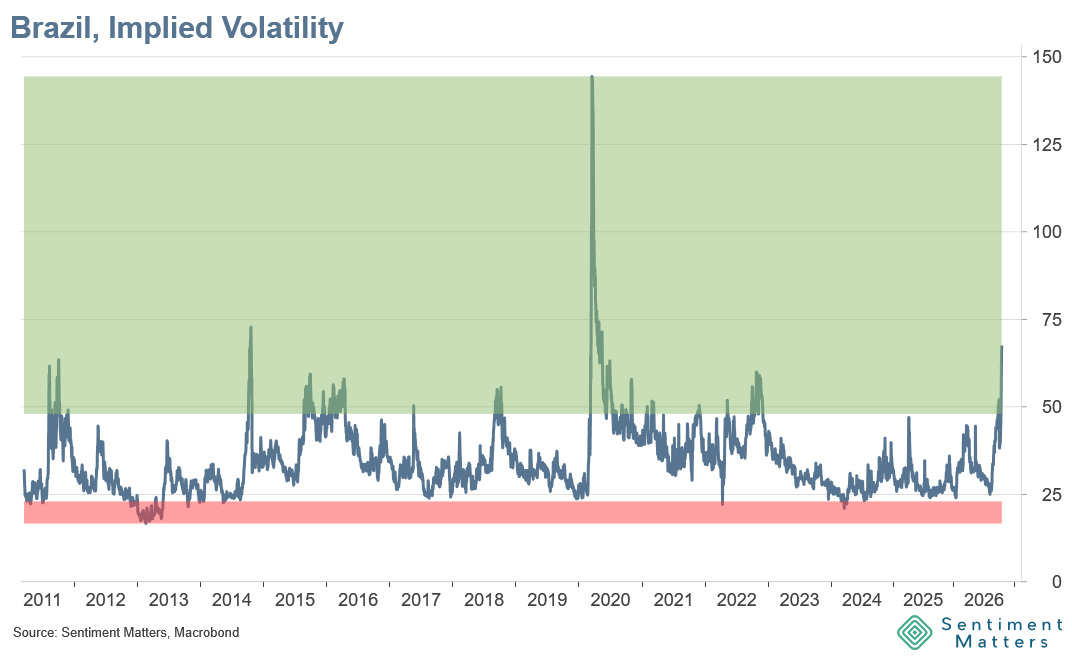
More precisely, we use the implied volatility gap between Brazil and the US, reflecting our relative-value perspective on Brazilian equities. Higher Brazilian implied volatility relative to the US enters the aggregate as greater bearishness. But the interpretative issue remains the same.
Removing implied volatility from the calculation takes the Brazil SMA to the 76th percentile. That is well into bullish territory, but not yet at the peaks previous Brazil equity rallies have reached or at the historical sell threshold that has been followed by Brazil underperformance at a high hit rate.