

The sharp rise in bond yields has prompted plenty of debate about what it means for equity markets. I have come across quite a few comments recently that, in my view, oversimplify or misunderstand the relationship between the two.
So this note is a little off the usual Sentiment Matters track. Rather than looking at investor sentiment and positioning, I am putting my old equity strategist hat back on to revisit what the historical evidence tells us about the relationship between equities and bond yields. Think of it as a bit of an equity and bond yield primer. Not quite the usual Sentiment Matters research, but hopefully something you'll find useful and worth saving for the next time bond yields rise and the questions start about why equities aren't falling.
The bottom line is that rising bond yields are not necessarily bad for equities. In fact, historically equities have risen alongside bond yields more often than not. But the relationship depends on what is driving yields higher, how quickly they rise and where they start from.
It is tempting to think of rising bond yields as a straightforward headwind for equities. Higher yields increase the discount rate applied to future earnings, make bonds more attractive relative to equities and eventually raise financing costs for companies. All else equal, that should be bad news for equity markets.
But all else is rarely equal.
Bond yields do not rise in isolation. They reflect changes in growth expectations, inflation, monetary policy, risk premia and investor positioning. And some of those same forces can be positive for equities.
That helps explain why the empirical relationship between equities and bond yields is much less straightforward than the theoretical one.
The historical evidence is surprisingly positive
The empirical evidence challenges the conventional view that rising bond yields are necessarily bad for equities.
Looking at 25 episodes of sharp increases in US Treasury yields since 1979, the S&P 500 rose in 21 of them. On average, 10-year Treasury yields increased by almost 200 basis points, while the S&P 500 gained 6.2%.
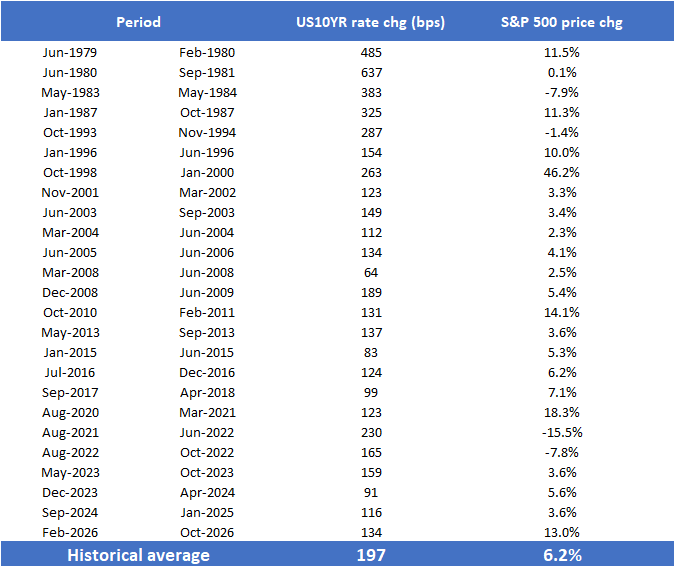
That is hardly consistent with the idea that rising bond yields are inherently bad news for equities.
The more recent evidence has been somewhat more mixed. Equities fell sharply during the 2021–22 inflation and monetary tightening shock, and again during the subsequent rise in yields in the second half of 2022. However, they have performed positively during each of the four subsequent episodes.
Of course, the historical averages hide considerable variation. Equity returns have ranged from a gain of more than 46% during the 1998–2000 increase in Treasury yields to a decline of 15.5% in 2021–22.
The sample also consists of selected periods of rising yields rather than a systematic assessment of all changes in bond yields. It establishes an interesting historical pattern, not a reliable trading signal.
Nevertheless, the message is clear: the direction of bond yields alone tells us surprisingly little about the direction of equity markets. What matters much more is why yields are rising.
1. The driver of higher yields matters
Perhaps the most important distinction is between yields rising because of stronger growth expectations and yields rising because of inflation or other risk premia.
Ultimately, equity prices depend on two things: expected future earnings and what investors are willing to pay for those earnings. Higher bond yields can put pressure on the second, but that does not necessarily mean equity prices have to fall.