

Is it just me or is the vast number of economic policy uncertainty indices confusing? You come across charts in research and on LinkedIn that supposedly show the same data, called US economic policy uncertainty, but the charts all look different! What’s going on?
I decided to dig deep into economic policy uncertainty to get my head around it once and for all.
This is the first of two notes on Economic Policy Uncertainty. Here I focus on what the different indices actually measure and why they can diverge; in Part 2, I’ll look at whether they have actually worked as contrarian sentiment indicators for equity markets.
First of all, there are several distinctly different US economic policy uncertainty datasets, built for different jobs:
- Main news index (extends back to 1900)
- 3-component “headline” index (starts in 1985)
- Categorical (topic) EPU (news-only, split into sub-categories)
Plus a daily series of the main news index. This can offer insight when news flow is changing quickly, but can be very volatile and noisy on a day to day basis.
These indices will often diverge—especially when the news cycle is doing one thing and macro-policy mechanics / forecast dispersion are doing another.
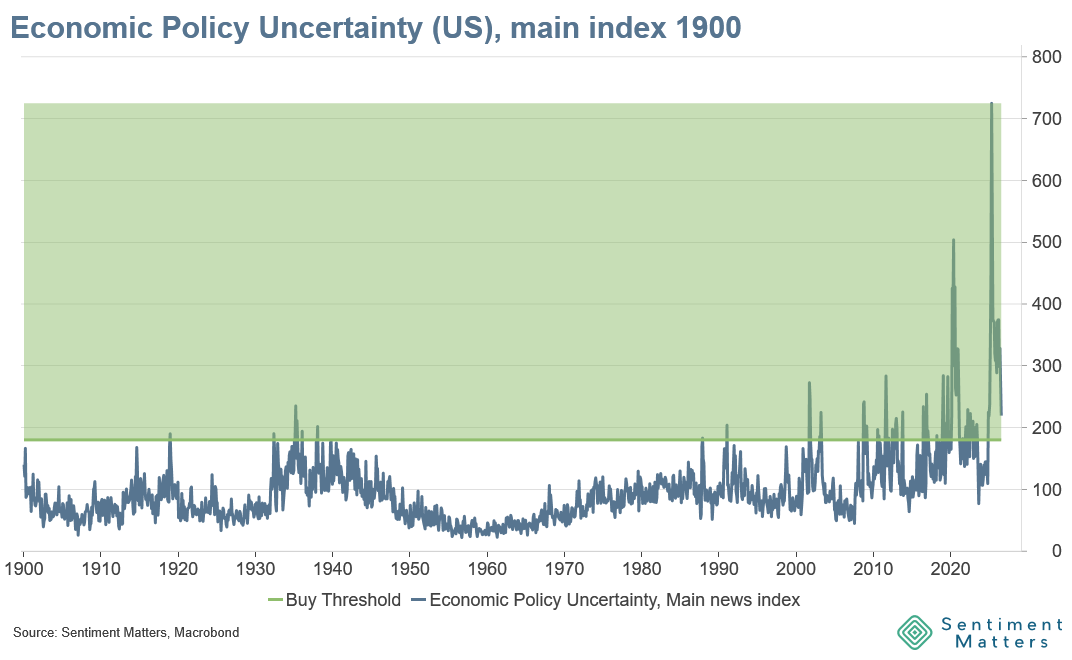
1) Main news index (back to 1900): “What’s in the headlines?”
What it is
A newspaper-based EPU series extended back to 1900. This index uses a relatively small set of ten US newspapers and is designed to give you a century-scale history of policy uncertainty as reflected in news coverage.
How it’s built
Month-by-month searches of newspapers for articles containing an uncertainty term (e.g. uncertain/uncertainty), an economy term (e.g. economy/economic etc.) and one or more of the following terms: 'congress', 'legislation', 'white house', 'regulation', 'federal reserve', or 'deficit'.
Pros & cons
- This is the cleanest measure of the policy uncertainty narrative across a very long history.
- It’s also the most exposed to media intensity / salience.
When it shines
- Long-run context: “Is this period unusual vs the 1930s / 1970s / GFC / etc.?”
- Regime comparisons over decades.
2) Three-component EPU (from 1985): “Noise-filtered policy uncertainty”
What it is