

As geopolitical risk has wound down, does that mean the end of Trump-induced market crises? Or does it simply make it more likely that attention shifts to the next source of uncertainty?
In keeping with the mantra of “prepare, don’t predict”, the important question is not whether a new trade war is certain, but what could come next and how investors should prepare for it.
One contender is a return to trade tensions. Could the announcement of new tariffs on Brazil be a harbinger of more to come?
From a sentiment perspective, this is clearly not a topic that has been at the top of investors’ minds.
One useful way to track it is the Trade Policy Uncertainty Index.
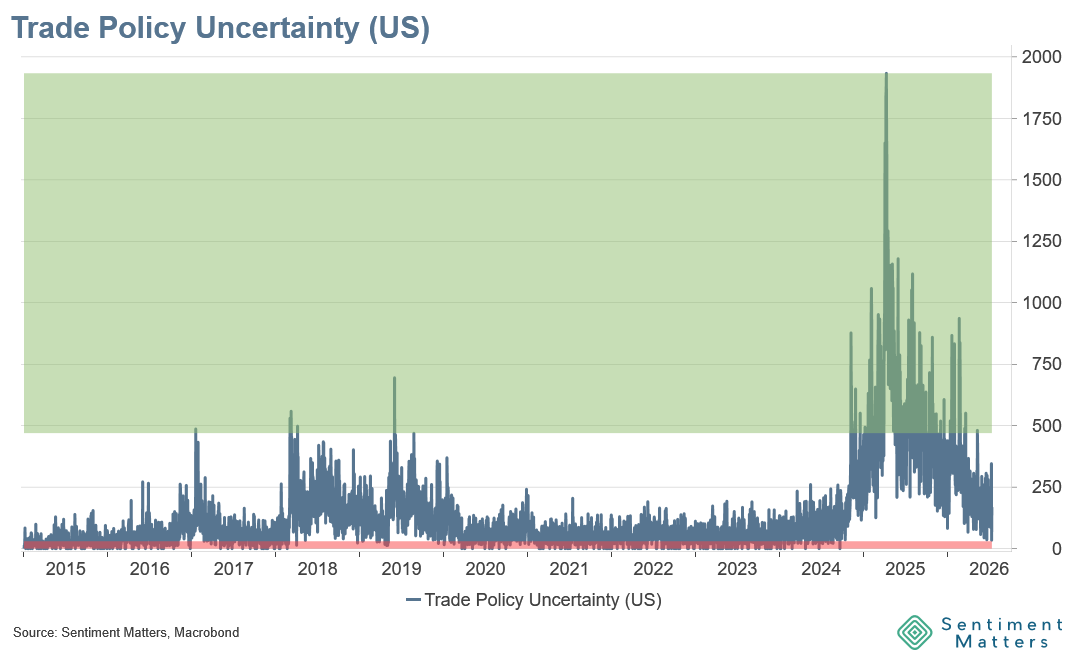
What is it?
The Trade Policy Uncertainty Index, or TPU, is a news-based measure developed by Caldara and colleagues.
It tracks how frequently major newspapers discuss trade policy alongside words associated with uncertainty, risk or threats.
Like the Geopolitical Risk Index, it measures the intensity of media attention rather than predicting what policymakers will do next.
Why it matters
Last year’s Liberation Day sell-off may be all the evidence investors need that trade-policy shocks can matter for markets.
Fundamentally, tariffs can affect growth, inflation, supply chains and corporate profits. But they can also trigger an immediate rise in uncertainty and risk aversion that proves more severe than the eventual economic impact.
A useful contrarian tool
Our backtests suggest that Trade Policy Uncertainty has been useful in generating contrarian sentiment signals.